Why Demand for CAD Conversion Services Will Surge in 2026

In the past decade, the architecture, engineering, construction (AEC), and manufacturing sectors have undergone tremendous digital transformation. Yet 2026 is shaping up to be a tipping point a year when demand for CAD Conversion Services is expected to surge more sharply than ever.
Why? Because organisations in the UK and globally are facing intense pressure to modernize legacy drawings, streamline design workflows, and accelerate project delivery. Whether you’re a business owner, architect, engineer, manufacturer, tech strategist, or startup founder, the coming shift will affect your operations directly.
This article breaks down why 2026 will be a milestone year, which trends are fueling the change, and what opportunities this creates for design-driven businesses. It also highlights how companies preparing now will gain a competitive edge by using services that help them convert 2D drawing to 3D model, migrate older files, and future-proof their systems.
Why Is the Industry Moving Away from Legacy 2D Drawings Faster Than Ever?
For decades, many UK businesses have relied on scanned blueprints, paper drawings, and outdated 2D CAD files. But as digital requirements accelerate, these formats are becoming a bottleneck.
Three primary forces are driving the need for 2D to 3D conversion drawings:
1. Rising BIM adoption across UK and EU markets
The UK already leads Europe in BIM maturity due to the government’s Level 2 BIM mandate. According to the National BIM Report, 73% of UK professionals now use BIM in some form a figure growing annually.
As BIM expands deeper into the private sector, businesses must migrate legacy 2D drawings to intelligent 3D models to stay compliant and to work seamlessly with partners.
2. Pressure from global supply chains
Manufacturers and engineering teams increasingly share 3D datasets, not 2D drawings. Suppliers that cannot provide accurate 2D drawing to 3D model conversion outputs risk losing contracts to more digitally capable competitors.
3. Faster design cycles and automation workflows
3D models reduce manual work, minimize clashes, and integrate with simulation tools. This speeds up timelines a core reason 3D is becoming the new default.
Several technology and industry shifts are converging at once.
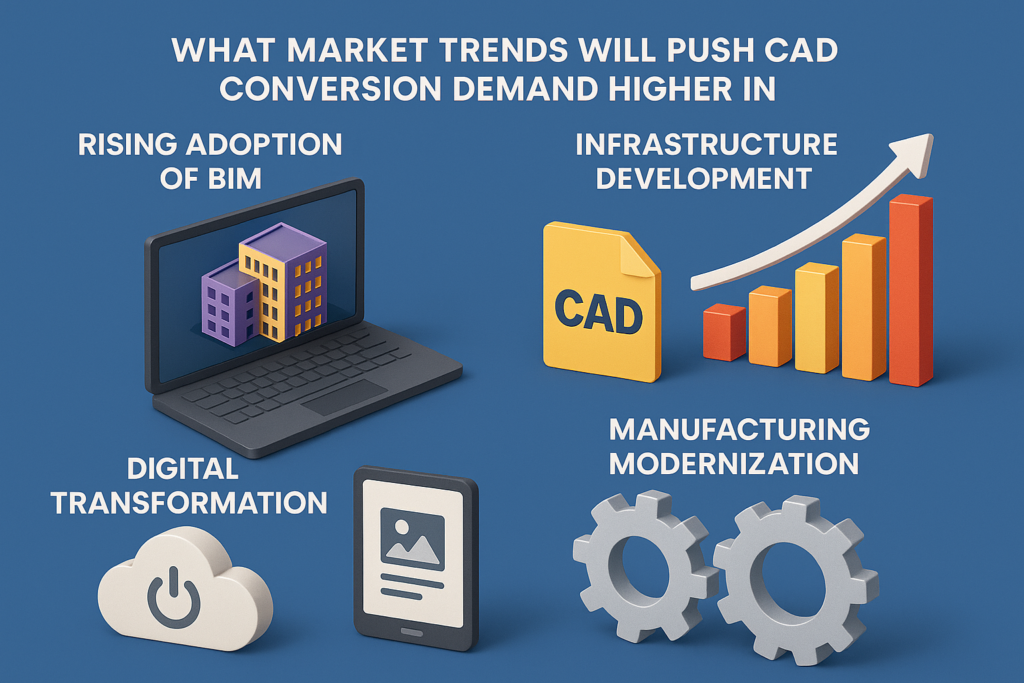
What Market Trends Will Push CAD Conversion Demand Higher in 2026?
1. Accelerated adoption of AI-driven design tools
AI is transforming CAD. But AI works best with clean, structured datasets not old scans or messy drawing files.
According to PwC, AI will contribute an estimated £200 billion to the UK economy by 2030.
As generative design, automation, and AI-powered drafting tools become more mainstream in 2026, companies will need high-quality 3D models as input.
2. Expansion of digital twins and virtual simulation
The global digital twin market is expected to reach US$183 billion by 2031, according to Allied Market Research.
(Source)
Digital twins rely on accurate 3D representations not outdated 2D drawings. This alone will drive huge demand for CAD file conversions.
3. Growing retrofit, renovation, and sustainability projects
The UK’s push toward Net Zero is accelerating upgrades across infrastructure, housing, utilities, and commercial property.
The government has allocated billions for energy efficiency initiatives, and retrofitting requires precise as-built documentation.
This surge in renovation projects is creating a huge need to convert 2D drawing to 3D model formats that can integrate with BIM and energy modelling tools.
What Are the Biggest Challenges Pushing Businesses Toward CAD Conversion?
Even in 2025, many organizations still struggle with:
1. Disorganized archives and file types
Firms often hold decades of drawings in multiple formats DWG, DXF, scanned PDFs, hand sketches, or proprietary software. Working with these files slows teams down.
2. Inefficient collaboration and handovers
With hybrid and global teams now common, sharing inconsistent drawing formats creates friction. 3D models standardize communication.
3. Compliance and project documentation pressure
Public and private projects increasingly require structured digital information. Converting drawings to modern CAD formats ensures audit ability and reduces errors.
4. Ageing workforce knowledge loss
Retiring engineers often hold crucial knowledge of old drawings. Converting these documents preserves institutional memory before it’s too late.
These challenges are reaching a breaking point especially for manufacturing, construction, architecture, and product engineering companies.
How Will Industries Benefit from Converting 2D Drawings Into 3D Models?
Businesses adopting 2D to 3D conversion drawings in 2026 will unlock several strategic advantages:
Enhanced project accuracy
3D reduces misinterpretation, avoids construction clashes, and provides a single source of truth for teams.
Improved speed and efficiency
Converting old drawings accelerates:
-
on-boarding for new hires
-
design revisions
-
prototyping
-
digital collaboration
-
compliance submissions
Better forecasting and simulation
3D models integrate with:
-
structural analysis tools
-
energy simulations
-
manufacturing automation
-
digital twin platforms
-
clash detection systems
This results in fewer costly surprises on-site or in production.
Seamless integration with modern technologies
Once models are digitized, they can plug into:
-
AR/VR for virtual walkthroughs
-
AI-assisted design
-
Automated manufacturing workflows
-
Robotic construction systems
In short: 3D is the gateway to Industry 4.0.
Which Sectors Will Drive the Most CAD Conversion Demand in 2026?
While nearly all industries benefit, these sectors will lead the surge:
1. Architecture & Construction
Due to BIM mandates, digital twins, and sustainability requirements.
2. Manufacturing & Engineering
OEMs and suppliers require unified 3D data to streamline product development.
3. Energy, Utilities, and Infrastructure
As ageing UK infrastructure undergoes upgrades, 3D models are essential for safety and planning.
4. Real Estate & Facilities Management
More commercial buildings are adopting 3D asset management.
5. Heritage & Conservation
Historic buildings require digitization to preserve structural details.
Why 2026 Specifically? What’s the Trigger?
Several developments are converging, making 2026 a landmark year:
1. UK regulatory shifts and digital mandates
More industries will face digital documentation requirements similar to BIM standards. Conversions will be unavoidable.
2. Maturing AI and automation tools
By 2026, AI-enabled CAD tools will be far more accessible. Companies will need clean 3D data to use them effectively.
3. Construction and manufacturing recovery cycles
As post-2024 economic recovery strengthens, more capital projects will begin all requiring modern digital assets.
4. Workforce transformation
Younger, digitally-native professionals are demanding 3D-based workflows, accelerating organisational change.
What Should Businesses Do Now to Prepare for the 2026 Surge?
Here’s a simple road-map:
-
Audit all existing drawings
Identify what needs to be digitized or modernized. -
Priorities critical projects
Focus on the drawings needed for upcoming contracts or compliance requirements. -
Standardize file naming and storage
Create a consistent format for future use. -
Convert legacy files early
Avoid the rush when demand spikes in 2026. -
Invest in continuous digital skills training
Your team must be ready to work with 3D and BIM models. -
Partner with experienced CAD professionals
Accurate conversion requires both technical and industry knowledge especially for complex or older drawings.
Conclusion:
2026 will be a breakthrough year for the CAD industry not just because technology is accelerating, but because businesses can no longer afford inefficiencies tied to outdated drawings.
Organisations that start preparing now will be able to innovate faster, reduce project risk, and maintain a competitive position in the digital-first era.
If your business needs support to convert 2D drawing to 3D model, migrate legacy files, or prepare for BIM and digital twin adoption, partnering with an experienced UK-based team can make the journey smoother. A leading UK CAD design company can help guide you through the transition with precision, speed, and industry expertise.