Browser Games vs. Downloadable Games: Best for Casual Players
You have ten minutes before your next class, a long wait at the bus stop, or a short gap between meetings. You want to play something, but you don’t want to sit through a 4 GB download, create an account, and click through a tutorial first.
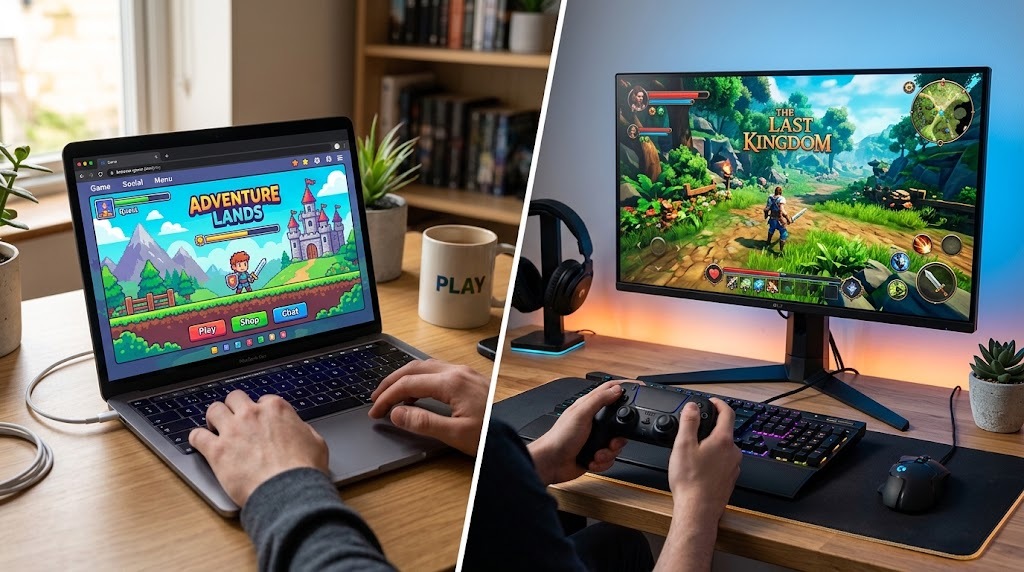
That moment is a good picture of the choice casual players face. Some games open in a browser tab and are playable in seconds. Others need to be installed on a computer, phone, or console, and they reward that effort with more depth and polish. Neither approach is wrong, but one will probably suit your habits better. This guide compares them so you can decide.
What Are Browser Games?
Browser games run inside a web browser such as Chrome, Firefox, Safari, or Edge. You visit a webpage, the game loads, and you start playing. Nothing is installed in the traditional sense, though your browser may cache some files so the game loads faster next time.
The biggest advantage is how little friction there is. If you have a device with a modern browser, you can usually play on a school computer, a work laptop (if your workplace allows it), an older machine, or a Chromebook. There’s no storage to free up and no installer to run.
A good example is Tiny Fishing, a simple game where you cast a line, catch fish, and use your earnings to upgrade your gear. The rules are easy to understand within seconds, a session can last two minutes or twenty, and you need no special hardware. Games like this show what browser gaming does best: low commitment and immediate fun.
Browser games do have limitations:
- They usually need an internet connection, at least to load the game. Some keep working offline once loaded, but many don’t.
- Graphics and scale are often modest, because games must load quickly and run in a browser environment.
- Progress saving can be unreliable. Some games store progress in your browser, so clearing your data could erase it.
- Ads are common, since many free browser games rely on advertising.
What Are Downloadable Games?
Downloadable games are installed on your device, whether that’s a Windows PC, Mac, smartphone, tablet, or console. You get them from a store such as Steam, the Epic Games Store, the App Store, Google Play, or a console marketplace, and they live on your device’s storage.
Because they run natively on your hardware, they can take full advantage of your processor and graphics card. That usually means richer visuals, larger worlds, more complex mechanics, and long-term progression systems like story campaigns, character builds, and online communities.
Many downloaded games also work offline, which is useful on flights, commutes through tunnels, or in areas with poor connectivity. Support varies by title, though, and some downloadable games still require an online connection.
The tradeoffs are practical:
- Installation takes time. Large games can take a long while to download and set up.
- Storage is a real constraint. A few big titles can fill a phone or laptop quickly.
- Updates are frequent. Patches may arrive just when you want to play.
- Costs vary. Some games are free, some charge upfront, and others offer free entry with optional purchases or subscriptions.
Browser Games vs. Downloadable Games: Key Differences
Here is how the two formats generally compare. Individual games will vary, so treat this as a guide to typical patterns rather than a rule.
Which Option Is Better for Casual Players?
It depends on how and when you play.
Browser games tend to win for short, spontaneous sessions. If your gaming happens in small gaps in the day, instant access matters more than visual detail. Being able to open a tab, play for five minutes, and close it without any cleanup is hard to beat. That’s also why browser gaming works well for students, shared computers, and older devices.
Variety is another strength. Casual browser sites often host fishing games, puzzles, platformers, arcade-style titles, and quick competitive games. A title like boxing random, for instance, fits the pick-up-and-play style that suits browser gaming: short rounds, simple controls, and the kind of lighthearted competition you can enjoy with a friend on the same keyboard or on your own. Since features vary by site and version, check the game’s own page for details like controls and modes before you play.
Downloadable games make more sense when you want something to grow into. If you enjoy unlocking new abilities, following a story, building a collection, or playing consistently with the same online community, a downloaded game usually offers more to work with. They’re also the better choice if you want a stable offline experience or smoother, more detailed graphics.
A rough rule of thumb: if you want to play right now, browser games are usually the answer. If you want to play for months, downloadable games often have more staying power.
Pros and Cons of Both Gaming Formats
Browser Games
Pros
- Instant access with no installation
- Works on many devices, including modest or older ones
- Usually free to try
- Easy to dip into for a few minutes
- Uses little or no storage
Cons
- Often needs a steady internet connection
- Graphics and depth are usually more limited
- Progress may not save reliably
- Ads can interrupt play
- Quality and safety vary between sites
Downloadable Games
Pros
- Typically better graphics and performance
- Deeper gameplay and longer progression
- Many titles work offline
- Reliable saving, often with cloud backup
- Access to larger communities and features
Cons
- Installation and updates take time
- Can use significant storage
- May require a purchase or include in-game spending
- Hardware requirements can exclude older devices
- Less convenient for a quick five-minute break
How to Choose the Right Gaming Experience
Ask yourself a few practical questions:
How much time do you usually have? If you play in short bursts, start with browser games. If you can set aside an hour or more, a downloadable title may be more rewarding.
What can your device handle? Older laptops, school computers, and low-storage phones work well with browser games. A modern device with free space opens up more downloadable options.
How reliable is your internet? If your connection is weak or unpredictable, favor downloadable games that support offline play. If you’re always online, browser games lose that disadvantage.
What’s your budget? Browser games are mostly free, though ads are the tradeoff. Downloadable games range from free to expensive, so read the pricing model before you commit.
What kind of gameplay do you enjoy? Simple, repeatable fun points to browser games. Stories, strategy, and long-term goals point to downloads.
Are you willing to install software? If the answer is “not really,” that settles much of the question. And if you do try browser games, stick to reputable sites, avoid unexpected download prompts, and be cautious about sharing personal information.
Conclusion
Browser games offer speed, simplicity, and almost no setup, which makes them a natural fit for quick breaks and casual curiosity. Downloadable games offer depth, polish, and offline reliability, which suit players who want a richer, longer-term experience.
Neither format is universally better. The right choice comes down to your schedule, your device, your connection, and what you actually enjoy. Many casual players end up using both: browser games for spare minutes, and a downloaded game or two for evenings and weekends.