How Vertical Conveyors Move Crops Through A Stacked Indoor Farm
There was a time when farming meant wide fields and hundreds of acres. Not anymore. Inside climate-controlled buildings, crops now grow in stacked layers that climb toward the roof, fed by light and water measured out to the drop. That shift, from spreading out to building up, is quietly changing how fresh food gets to crowded cities.
But all that climbing only works if you can move plants between the levels. And nothing does it better than vertical conveyors, lifting trays and towers of crops from the floor up to the top tier and back down at harvest.
Why Stacking Beats Spreading
Land near a city is scarce and pricey. Growing outward burns through that ground fast, and it leaves crops exposed to harsh weather. Building upward changes that, taking a small footprint and stacking it into layer after layer of growing space.
One stacked room can hold the growing area of a field several times its size on the floor. That density is the whole point. It puts fresh produce right next to the people eating it and cuts out the long truck hauls the old supply chains leaned on. Shorter trips mean greener greens on the shelf and less waste along the way.
The Movement Challenge Inside
Stacking the crops fixes one problem and hands you another. Plants sitting way up on a rack still have to come down for tending and cutting. Try that by ladder or lift truck across thousands of trays and you’ve got something slow and unsafe.
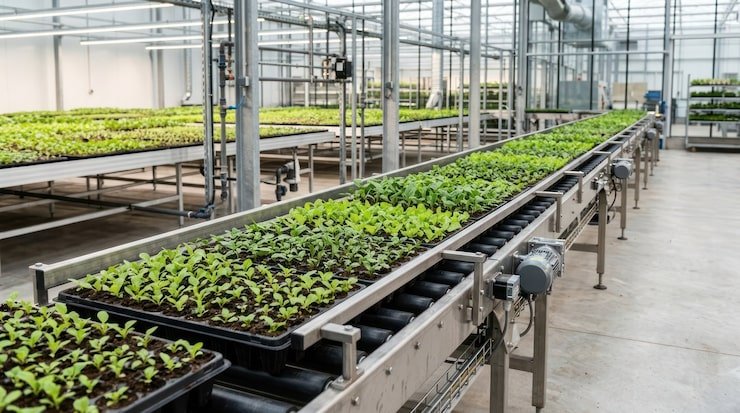
This is where automated lifting earns its spot. A well-built set of vertical conveyors raises and lowers crops along a set path, so workers stay on solid ground and let the plants come to them. The motion is gentle enough to spare tender leaves and roots, and it keeps a steady beat, so the flow never stalls waiting on somebody to fetch a tray.
Counting the Benefits
The pull of building upward comes down to a handful of clear wins. Each one adds to the case for stacking.
- More yield per square foot, since growing space multiplies with every layer you add.
- Shorter delivery runs, because the farm can sit right in the city or close to it.
- Harvests all year, since indoor climate control ignores the seasons outside.
- Less water used, thanks to systems that catch and recycle whatever the plants don’t drink.
Put those together, and it’s easy to see why investors and growers keep betting on the model. The math only gets better as cities fill up and open land gets harder to find.
Keeping Costs Under Control
The promise comes with a catch. Building upward is expensive, and the gear that moves the crops is a real chunk of that bill. Overspend on the movement side, and a grower can watch thin margins evaporate.
The fix is matching the machine to the task. Fast lifting belongs where crops move all the time, like the harvest cycle. Slower, simpler movement is plenty where plants mostly sit between planting and picking.
A Field That Keeps Climbing
Interest in vertical farming keeps building as the technology sharpens and costs ease off. What started as a niche experiment is already putting greens on the shelves of major grocery chains. The whole trend points up, literally and business-wise.
Even so, making it work hangs on nailing the unglamorous details, and how you move the crops sits near the top of that list. A farm can have flawless lighting and perfect nutrients and still trip over itself if it can’t move plants through those stacked racks. That’s a major part that quietly decides whether vertical farming turns a profit or burns cash.
Helping Indoor Farms Rise
Lifting systems built for modern indoor growing have to pull off two things at once: handle the plants gently and keep running without a hitch. Get that balance right, and crops move dependably from the ground floor clear up to the top, day in and day out. As more farms reach for the ceiling, it’s that steady, reliable movement that lets them climb confidently.