Plate Rolling Machine Manufacturer Selection Guide
Heavy fabrication is unforgiving.
When 30 mm, 40 mm, or 60 mm thick plates move through a rolling system, forces are not theoretical. They are violent. Steel resists. Frames flex. Bearings scream if undersized. Alignment errors multiply quickly.
Choosing the wrong supplier is not a minor inconvenience. It is a production liability that will sit on the shop floor for years.
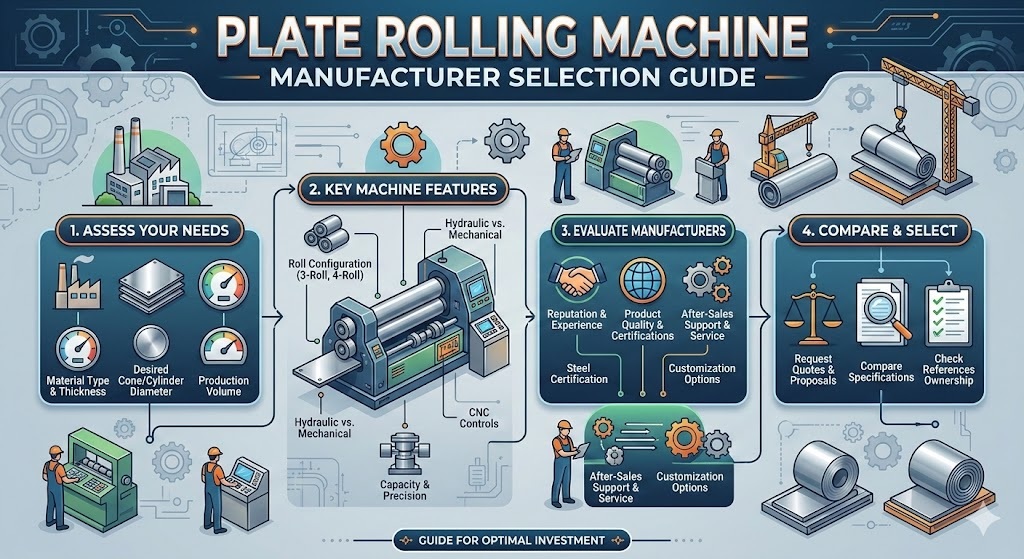
Selecting the right plate rolling machine manufacturer requires technical scrutiny, operational realism, and long-term thinking. Price comparisons are irrelevant without structural evaluation.
This is how serious fabricators approach the decision.
Start With Structure, Not Sales Talk
A rolling machine built for light fabrication cannot survive heavy-duty cycles. The difference lies in the frame.
Inspect the base construction. Is it fabricated plate welded together loosely? Or is it stress-relieved and structurally reinforced? Thick plates under high pressure try to twist frames. If the base distorts, roll parallelism collapses. Once that happens, consistent curvature becomes impossible.
A reliable plate rolling machine manufacturer designs machines where rigidity is engineered into the frame, not added cosmetically later.
Ask about stress relief procedures. Ask about frame machining tolerances after welding. Serious manufacturers answer clearly. Others deflect.
Roll Material and Surface Finish Matter More Than Advertised Capacity
Capacity numbers can mislead. What matters is roll diameter, material grade, and surface treatment.
Heavy plates require rolls that resist indentation and surface scoring. Inferior material causes micro-damage. Micro-damage becomes surface marking. Surface marking becomes rejection.
Evaluate:
- Roll hardness specification
- Heat treatment process
- Surface grinding precision
- Crown compensation design
Under heavy loads, roll deflection must remain predictable. Without precision engineering, the machine may claim high capacity but fail during real-world production.
A technically grounded plate rolling machine manufacturer never exaggerates tonnage ratings without backing them with structural proof.
Mechanical vs Hydraulic Drive — Know the Application
Heavy fabrication may require hydraulic rolling systems for flexibility and force distribution. Mechanical systems can be durable but less adaptable.
Understanding the fabrication profile is critical:
- Constant diameter shell production?
- Variable radius jobs?
- Conical bending requirements?
- High repetition production cycles?
The correct drive configuration depends on usage patterns. A manufacturer that pushes one configuration for all applications is not solving problems — it is simplifying inventory.
Engineering consultation should precede quotation.
Alignment Stability Under Load
Machines can appear accurate when idle. The real test begins when thick plate engages the rolls.
Under load, roll shafts must remain parallel. Frame distortion must remain within controlled tolerance. Bearings must distribute load evenly.
Ask how alignment is tested. Is load simulation performed? Are deflection values measured? Does the manufacturer provide structural calculation data?
A competent plate rolling machine manufacturer will demonstrate awareness of deflection behavior and compensation strategies.
Without that, curvature inconsistency becomes routine.
Precision Controls: Practical, Not Decorative
Digital control panels look impressive. The question is whether they contribute to accuracy.
In heavy fabrication, stored programs reduce operator variability. Automated end-roll adjustment improves repeatability. However, electronics must be integrated logically with mechanical design.
Machines that add digital panels without mechanical stability only create a false sense of precision.
Select a plate rolling machine manufacturer that integrates control systems with structural capability, not as an afterthought.
Maintenance Accessibility
Heavy equipment maintenance is inevitable. Bearings wear. Seals degrade. Hydraulic lines require inspection.
Examine the machine physically:
- Can critical components be accessed easily?
- Are lubrication points centralized?
- Is bearing replacement straightforward or complicated?
Poor design increases downtime and labor cost. Good design anticipates service needs.
Manufacturers who build machines with maintenance logic reduce lifecycle cost substantially.
Installation, Commissioning, and Operator Familiarity
Rolling thick plate is not intuitive for new operators. Without structured training, even a good machine produces inconsistent results.
A responsible plate rolling machine manufacturer provides commissioning assistance and technical guidance. That includes:
- Calibration during installation
- Live demonstration under production load
- Training sessions covering operational limits
Training reduces mistakes that damage rolls or overload drives.
Long-Term Spare Parts Roadmap
Availability of spare parts determines real uptime.
Evaluate:
- In-house manufacturing of critical components
- Stock availability of wear items
- Lead time for custom shafts or rolls
- Technical drawings access
If spare parts must be fabricated externally every time, downtime expands unpredictably.
Manufacturers with in-house machining capability protect customers from extended delays.
Customization Capability
Heavy fabrication is rarely identical from one project to another. Machines must adapt.
Important considerations include:
- Adjustable roll positioning
- Optional support arms for long plates
- Additional hydraulic stabilization
- Variable speed control
A flexible plate rolling machine manufacturer understands that equipment must evolve with fabrication demand.
Rigid catalog-only suppliers limit operational growth.
Evaluate Industrial Track Record
Years in operation matter. Installed machines matter more.
Request references from fabrication shops running similar plate thickness. Speak with operators. Ask about maintenance frequency. Ask about service responsiveness.
Real feedback from long-term users reveals more than any brochure.
Consistency over years separates durable engineering from promotional marketing.
Case Perspective: Structured Engineering at Siddhapura
Within India’s industrial machinery landscape, Siddhapura has established presence in heavy plate rolling solutions. Their design emphasis typically focuses on structural rigidity, roll precision, and mechanical durability.
Machines built with reinforced frames, accurate roll machining, and reliable drive assemblies reflect a production-oriented engineering philosophy rather than cosmetic presentation.
Fabricators evaluating suppliers often look for this structural depth when selecting long-term equipment partners.
Total Cost of Ownership Is the Real Metric
Initial price does not determine profitability. Lifecycle cost does.
Calculate:
- Energy consumption per hour
- Wear part replacement intervals
- Downtime losses
- Resale stability
- Upgrade potential
A slightly higher upfront investment often reduces operating cost significantly over five to ten years.
A strategic plate rolling machine manufacturer discusses lifecycle economics openly rather than competing solely on entry pricing.
Safety Architecture Cannot Be Ignored
Heavy plate movement generates force and inertia. Safety interlocks, emergency stops, overload protection systems, and guarding structures are essential.
Inspect safety features physically. Confirm overload protection calibration. Evaluate control redundancy.
Safety design reflects engineering seriousness.
Visit the Manufacturing Facility
A facility visit exposes manufacturing culture.
Observe:
- Welding consistency
- Machining accuracy
- Component storage organization
- Testing stations
- Assembly discipline
Orderly production environments usually correlate with machine reliability.
Disorganized production often reflects inconsistent quality control.
Practical Final Checklist
Before finalizing a supplier:
- Confirm structural calculations
- Evaluate roll metallurgy
- Verify load testing practices
- Inspect quality control process
- Assess spare parts strategy
- Confirm operator training provision
- Validate real-world references
Heavy fabrication does not forgive procurement shortcuts.
Closing Perspective
Selecting a plate rolling machine manufacturer for heavy fabrication is a structural decision. It affects productivity, dimensional accuracy, safety, and profitability.
The correct manufacturer builds machines that hold alignment under stress, maintain roll precision across cycles, and provide long-term support without uncertainty.
Steel remembers force. Equipment must be stronger than the force applied.
The right choice is rarely the loudest supplier. It is the one whose engineering holds steady long after installation — under load, under pressure, and under expectation.