How Many Days Are Enough to See the Wildebeest Migration?
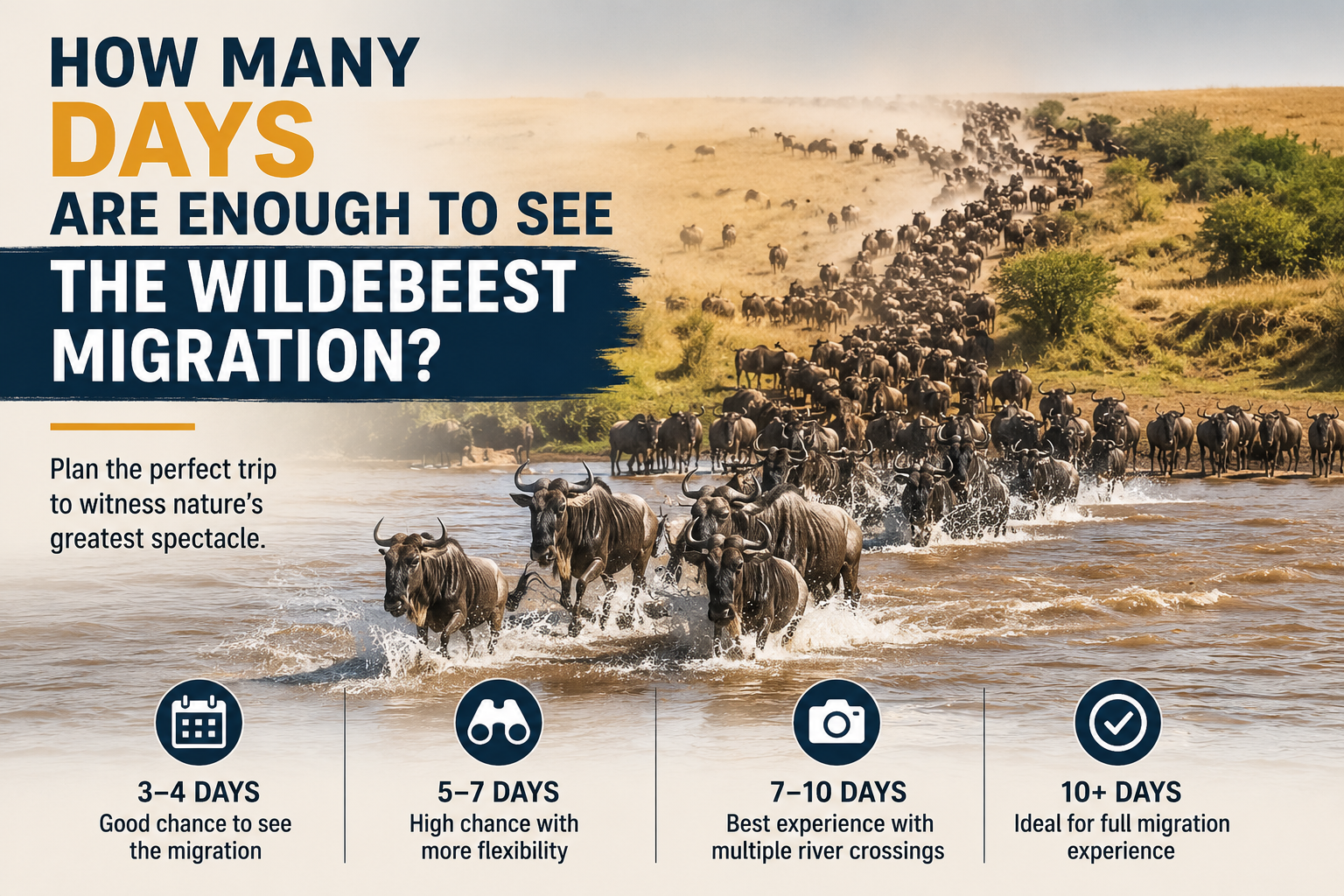
If you are a solo traveler trying to plan a 2026 Serengeti or Maasai Mara trip on a real budget, the honest answer is: it depends less on your calendar and more on your patience. Three days can work if you’re lucky with timing. Five days give you breathing room. Seven days is what most safari guides won’t tell you because it costs more to sell you a longer trip, but it’s usually what actually produces the moment you’re paying for.
Here’s what changes that answer, and how to make each day count without blowing your budget.
Why “How Many Days” Isn’t a Fixed Number
The Great Wildebeest Migration isn’t a scheduled performance; it’s roughly two million wildebeest, zebra, and gazelle moving in response to rainfall, not a calendar. A local Tanzania-based guide put it plainly in a mid-2026 planning note: the migration follows the rain, and the rain follows its own rules, so anyone promising you a crossing “on demand” is overselling the experience.
That uncertainty is exactly why trip length matters more than trip timing. A rushed one-night stop near a crossing point gives you a coin-flip chance. When planning Serengeti Wildebeest Safaris for 2026, most experienced operators recommend budgeting at least three to four nights near a crossing zone, not because it sounds impressive, but because wildebeest can gather on a riverbank for two days before committing to cross, or may not cross at all during your visit.
The Realistic Day-by-Day Breakdown
A simple day-by-day overview to help you track realistic progress.
3 Days: The Minimum, Not the Ideal
Three days is workable if you’re targeting the calving season (late January to March) in the Southern Serengeti or Ndutu, where wildlife density is high, and you don’t need to chase a single crossing event. It’s a poor bet for river-crossing season (July–October), when a short stay near the Mara River could easily land on a “quiet” day with no crossing at all.
Best for: Solo travelers with tight budgets who prioritize predator action and calving over the crossing spectacle specifically.
5 Days: The Sweet Spot for Most Solo Travelers
Five days let you split time between two zones, say, two nights in Central Serengeti (Seronera, reliable for big cats year-round) and three nights closer to the migration’s current position. This is long enough to absorb a slow day without wrecking your whole trip, and short enough to keep costs manageable.
Best for: First-timers who want a realistic shot at a crossing without committing to a luxury-length stay.
7+ Days: What Repeat Travelers Actually Book
Ask anyone who’s been twice, and they’ll usually say the same thing: the first trip felt rushed. A full week or a mobile-camp itinerary that follows the herd’s likely path dramatically increases your odds of witnessing a river crossing, because you’re not pinned to one location hoping the animals cooperate on your schedule. This is also the length of trip most African safaris and tours operators recommend if you want to combine the Serengeti with the Maasai Mara in one itinerary.
Best for: Travelers combining Tanzania and Kenya legs, or anyone treating this as a once-in-a-few-years trip worth stretching the budget for.
A Quick Case Study: Two Solo Travelers, Same Week, Different Outcomes
Two travelers I’ve seen described in trip reports booked the same late-August week in the Northern Serengeti. One stayed two nights near a single crossing point and left without seeing a crossing; the herd hesitated on the far bank the entire time. The other stayed four nights with a mobile camp that repositioned based on daily herd reports and caught a crossing on day three. Same season, same general area, completely different experience and the difference wasn’t luck, it was buffer time.
Budget Tips for Solo Travelers Planning 2026
- Travel in shoulder months if budget is tight. April and May see accommodation rates drop noticeably compared to peak season, while still offering strong game viewing in Central Serengeti; you just won’t be chasing a crossing.
- Book calving season (January–March) instead of crossing season if cost matters more than the river-crossing photo. It’s genuinely spectacular, less crowded, and often cheaper than July–September.
- Choose fixed camps over ultra-premium mobile camps if you’re solo. Mobile camps that follow the herd are excellent but pricier; a well-located fixed camp in the right month can deliver similar sightings for less.
- Add one extra night rather than one extra activity. Time near the herd consistently outperforms add-on excursions for the odds of seeing a crossing.
- Book 10–12 months ahead for July–September. Camps near Mara River crossing points fill far in advance for peak season, and last-minute solo bookings often mean paying single-supplement rates on whatever’s left.
- Ask your operator directly where the herd is now, not where it “should” be. Migration timing shifts by weeks depending on rainfall, so a guide working with recent, on-the-ground reports is more valuable than any generic calendar.
So, How Many Days Do You Actually Need?
If you can only manage three days, go for calving season and set realistic expectations. If you have five, you’re in solid territory for a first migration safari. If you can stretch to seven or more, especially with a mobile or semi-mobile camp, you are giving yourself the best realistic chance at seeing the migration’s most dramatic moment: a live river crossing, not just a video of one.
The migration will still be there next year. But the extra day or two you budget for this year is usually what decides whether you see it or just miss it by a few hours.
Frequently Asked Questions
1. What is the minimum number of days needed to see the wildebeest migration?
Three days is the practical minimum, but it works best during calving season (January–March) when wildlife density is high and you are not relying on one specific crossing event. During river-crossing season (July–October), three days is riskier a single crossing point can stay quiet for two or more days.
2. Is 5 days enough for a wildebeest migration safari?
Yes, for most solo travelers, five days is a realistic sweet spot. It gives you enough buffer to split time between two zones (like Central Serengeti and a crossing area) without the cost of a full week-long trip.
3. How many days should I budget specifically for a Mara River crossing?
Plan for at least three to four nights near a crossing zone. Wildebeest often gather on the riverbank for a day or two before committing to cross, so a one- or two-night stay significantly lowers your odds of witnessing it.
4. Is it cheaper to see the wildebeest migration during calving season instead of crossing season?
Generally, yes. Calving season (January–March) and shoulder months like April–May typically come with lower accommodation rates than the July–September peak crossing season, while still offering strong wildlife viewing.
5. Do I need to book Serengeti Wildebeest Safaris far in advance for 2026?
For July–September travel yes, camps near Mara River crossing points can fill up 10–12 months ahead. If you’re flexible on timing, shoulder-season trips can often be booked with much shorter notice.
6. Can I combine Tanzania and Kenya in one migration trip?
Yes, and many 7+ day itineraries do exactly this, starting in the Serengeti and ending in the Maasai Mara (or vice versa), depending on where the herd is positioned during your travel dates.