Healthcare App Development: What to Expect in the Coming Years
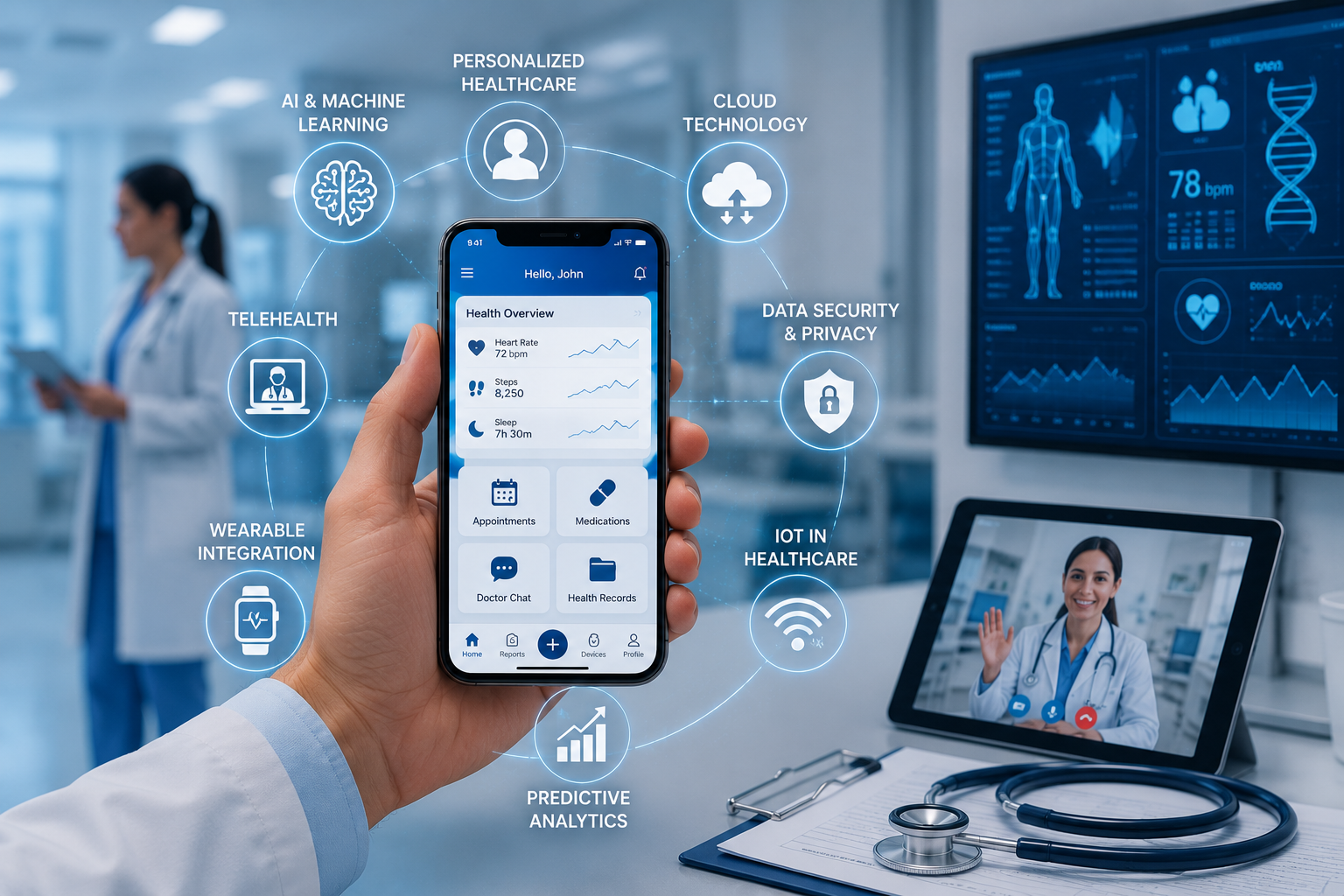
Dr. Priya had been practicing family medicine in Toronto for sixteen years. She’d watched electronic health records transform from a bureaucratic imposition into a tool she genuinely relied on. She’d seen telehealth go from a fringe offering to a patient expectation in two years. She’d watched a continuous glucose monitor on her patient’s arm replace three clinic visits a month with a single fifteen-minute review. Each of those shifts had changed how she practiced medicine, sometimes in ways she’d resisted initially and later couldn’t imagine working without.
When she joined the advisory board of a digital health startup last year, her role was specifically to help a healthcare app development company understand what clinical workflows actually looked like from inside them, rather than from the outside looking in. What she brought to those conversations was a clinician’s perspective on which technologies were genuinely changing care and which were generating excitement without clinical utility. Here’s what that distinction looks like across the trends that will define healthcare app development over the next several years.
AI Moving From Support Tool to Clinical Partner
The integration of AI into clinical workflows has moved past the hype cycle into a more sober, evidence-driven phase, and what’s emerging is genuinely more useful than what preceded it. Early healthcare AI was largely about automating administrative tasks: appointment scheduling, prior authorization, claims processing. These applications delivered real value but didn’t fundamentally change clinical care.
The current generation is different. Ambient clinical documentation tools, where a microphone and large language model listen to a patient encounter and generate a structured clinical note, are reducing the documentation burden that’s consistently cited as a driver of clinician burnout. The studies coming out of early deployment sites are showing documentation time reductions significant enough that physician groups who’ve adopted these tools are resistant to giving them up.
Diagnostic AI in radiology, pathology, and ophthalmology has moved from research demonstration to routine clinical use in several health systems. The models aren’t replacing radiologists. They’re functioning as a second reader that flags anomalies for human review, improving sensitivity without requiring additional clinician time. The regulatory pathway for these tools, FDA clearance under the Software as a Medical Device framework, has become well enough understood that development teams can navigate it with greater predictability than three years ago.
For Dr. Priya’s primary care practice, the most relevant near-term AI application is predictive risk stratification: identifying patients at elevated risk of hospitalization or deterioration before the clinical deterioration is obvious, allowing proactive outreach rather than reactive care. The data infrastructure required, pulling from EHR systems, wearable data, and social determinants, is complex, but the health systems that have deployed these tools are seeing measurable improvements in outcomes for the highest-risk patient populations.
Remote Patient Monitoring as Standard of Care
Remote patient monitoring has graduated from a pandemic adaptation to a permanent feature of chronic disease management. The reimbursement infrastructure in the US (CPT codes 99453, 99454, 99457, and 99458), the UK (NHS virtual ward frameworks), and an increasing number of other markets has legitimized RPM as a billable clinical activity rather than a technology experiment.
The device ecosystem has matured in parallel. Continuous glucose monitors from Dexcom and Abbott have made real-time glucose data routine for type 1 and type 2 diabetes management. Connected blood pressure cuffs from companies like Omron and Withings feed hypertension management programs. Patch-based cardiac monitors from iRhythm and Zio are extending arrhythmia detection beyond the traditional Holter monitor’s twenty-four-hour window.
The clinical software connecting these devices to care teams is where the development opportunity lies. The devices themselves are largely solved problems. What’s underbuilt is the workflow software that helps a practice care coordinator manage a panel of two hundred remote monitoring patients efficiently, surfacing the alerts that require action while filtering out the noise. That’s a product design and clinical workflow challenge as much as a technical one.
Interoperability Finally Becoming Real
FHIR R4 has been a standard in development for years. What’s changed is enforcement. CMS interoperability rules in the US, NHS Digital’s FHIR implementation guidance in the UK, and the European Health Data Space regulation across the EU have created regulatory pressure that’s compelling health systems to actually implement FHIR-based data sharing rather than maintain proprietary silos.
The practical result is that healthcare app developers can now access patient data from major EHR systems, Epic through App Orchard, Oracle Health (formerly Cerner) through its developer program, Athenahealth through its Marketplace, through standardized APIs that weren’t usable at this level of completeness two years ago. A patient-facing application that aggregates health records from multiple institutions, something that required bilateral data agreements and months of integration work before, is now technically achievable through FHIR APIs in a meaningful fraction of that time.
The remaining challenge is implementation variation. FHIR as a standard allows significant flexibility in how specific data elements are represented, and different health systems have implemented the same standard in ways that don’t always interoperate cleanly. Experienced healthcare development teams have built the translation layers that handle this variation. Teams new to the space will discover it mid-project.
Mental Health Technology After the Market Correction
The mental health app market expanded aggressively between 2020 and 2023, with minimal regulatory oversight and widely varying evidence quality. The correction since then has been significant: several high-profile apps have shut down, regulatory scrutiny has intensified, and payers have started requiring evidence of clinical efficacy before covering digital mental health tools.
What’s emerging from this correction is a more credible product category. Evidence-based CBT applications developed in clinical partnership. Peer support platforms integrated into formal mental health care pathways. Measurement-based care tools that help therapists track patient progress systematically. These are products built with clinical rigor rather than consumer app development assumptions, and they’re finding more sustainable business models than the direct-to-consumer subscription apps that characterized the earlier wave.
Wearable Data Integration at Clinical Scale
The volume of physiological data being generated by consumer wearables, Apple Watch, Garmin, Whoop, Oura Ring,& Fitbit, has reached the point where the clinical question is no longer whether this data is useful but how to incorporate it into clinical workflows without creating a new documentation burden.
The answer emerging from forward-thinking health systems is passive integration: wearable data flows automatically into the patient record through Apple HealthKit and Google Health Connect, flagged algorithmically when it falls outside normal ranges, surfaced to the clinician only when it’s clinically actionable. The patient doesn’t have to remember to share it. The clinician doesn’t have to dig through raw data streams. The system surfaces what matters.
Building this kind of intelligent integration requires expertise in both the wearable data platforms and the clinical workflow software, a combination that’s rarer than either skill in isolation.
The Common Thread Running Through These Shifts
Looking across remote patient monitoring, AI-assisted documentation, FHIR interoperability, digital mental health, wearable integration, and the other threads shaping this space, Top 10 healthcare app trends shaping the next several years share a common characteristic: they’re maturing from proof-of-concept into production deployment, with regulatory frameworks catching up to the technology rather than leading it. That maturation changes what healthcare app development requires from a team. The question is no longer whether these technologies work. It’s whether a development team can build them to the standard of evidence, compliance, and clinical workflow integration that health systems and regulators now expect.
Regulatory Fluency as a Development Competency
Healthcare apps increasingly require development teams who understand the regulatory environment as a product design input rather than a compliance afterthought. FDA SaMD classification determines what clinical evidence is required before an app can make specific claims. HIPAA technical safeguards determine data architecture choices. GDPR and equivalent frameworks determine how patient consent is managed and documented. NHS DTAC requirements in the UK and MDR requirements in the EU create compliance obligations that affect development timelines and testing requirements.
A development team that discovers these requirements mid-project, rather than incorporating them from the start, creates compliance problems that are expensive to fix and potentially market-entry-blocking for products targeting regulated markets.
What Dr. Priya Brought to the Startup
Her most consistent contribution to the advisory conversations wasn’t clinical expertise exactly, it was the habit of asking whether a feature would actually change what a clinician did in a patient encounter. A lot of digital health technology generates data without generating insight, creates features without creating workflow, and launches products that clinicians acknowledge are impressive and then don’t use. The technology that changes care is the technology that fits into how care is actually delivered rather than asking care delivery to reorganize around the technology.
That distinction, between technology that changes practice and technology that demonstrates capability, is the organizing principle behind every healthcare app trend worth building for.